|

The quotations, short texts, and
photographs in this work remain the exclusive property of
their respective authors.
COMMON SENSE — Life’s
Compass
There are ideas that follow you everywhere, a bit like those
songs you don’t remember ever learning yet still find yourself
humming in the shower. They move with soft, muffled steps,
discreet but stubborn, like a cat pretending not to watch you
while very clearly judging you. They slip into your
conversations without warning, influence your decisions, from
the most trivial to the most dramatic, and hide in your
everyday observations, right where you thought you were only
seeing an insignificant detail.
In the most ordinary moments, they resurface: when you see
someone stumble over a mistake that was perfectly avoidable
(and you quietly think to yourself, “Ah, the classic
Monday‑morning trap…”), or when an entire team gets bogged
down in a problem that could have been solved by a simple
flash of lucidity, the very one that, of course, decided to
take the day off.
They also return in more serious moments, when we measure the
consequences of a poorly weighed choice, a judgment made too
quickly, or a truth we carefully tucked behind the curtain,
hoping it wouldn’t insist on coming back out.
That idea, for me, is common sense. A simple idea, almost
timid, not trying to steal the spotlight, yet always managing
to step back on stage to gently remind us: “Alright… let’s
refocus.” An idea, that doesn’t need any spotlights to
illuminate that never raises its voice but quietly puts
everything back in its place with the firm gentleness of a
grandmother straightening your collar before a photo.
Common sense is anything but a spectacular. It doesn’t make
noise, it doesn’t set off fireworks, and it doesn’t ask for
diplomas, titles, or even a little participation certificate.
And yet, it’s always there, faithfully on duty, like an inner
compass reminding us that clarity isn’t a luxury reserved for
the initiated, but a necessity, much like water, air, or
knowing where you left your keys. It’s that quiet voice
whispering: “Look again. Think it through. And above all,
don’t turn a glass of water into a three‑variable equation.”
Without you ever really decide it, common sense becomes a
traveling companion. Not the chatty or intrusive kind, more
like the silent passenger who occasionally raises an eyebrow
to steer you back to what matters. A discreet yet stubborn
guide who follows you everywhere, even when you pretend you
didn’t notice it.
Most of us have worked, directly or indirectly, with
organizations, leaders, employees, families, communities.
We’ve moved through shifting environments, taken part, in
ambitious projects, supported by people searching for meaning
or solutions. In short, we’ve seen people, chaos, and even a
few meetings that really should have been emails.
We have witnessed extraordinary
transformations: teams rising again against all odds,
individuals discovering within themselves a courage they
thought they had tucked away, and bursts of creativity capable
of unlocking situations that even a GPS would have given up
on.
These moments reinforce the conviction that human beings are
capable of their very best when they act with clarity,
coherence, and intention. But we’ve also seen the other side:
promising projects collapsing for no apparent reason,
professional relationships deteriorating over tiny details
(sometimes smaller than a Post‑it), and crucial decisions made
too fast, too late, or for reasons that would make even a
fatalistic philosopher sigh. And almost always, the same
realization emerges, common sense had been forgotten somewhere
along the way—probably right next to the coffee machine
faced with these familiar scenes, a thought returns,
persistent, almost painful: “We could have avoided this. We
could have done better. We could have thought differently.” It
isn’t a judgment of others, but a shared lucidity. An
acknowledgment that, often, what’s missing is neither
intelligence, nor skills, nor goodwill… but simply, a return
to what, truly matters.
For common sense is not some mysterious talent reserved for a
chosen few. It doesn’t depend on education level, social
status, or professional experience. Common sense is a daily
practice, an inner discipline, an honest look at reality—even
when it unsettles us, contradicts our preferences, or reminds
us that, yes, sometimes we really should have reread
that email before hitting send.
It is the ability to say: “Here is what is. Here is what I
see. Here is what I must do.”
Without detours, without
illusions, without unnecessary justifications, in short,
without all the mental folklore we love to add just to
complicate our lives.
At its core, common sense is that quiet strength that brings
us back to the right kind of simplicity, to the clarity we
need, to the obvious truth we had carefully tucked behind a
curtain, probably hoping no one would notice. And perhaps that
is why it is so precious: it reminds us that wisdom doesn’t
hide in conceptual labyrinths, but in the truth of the real
world—that stubborn thing that refuses to bend to our
imaginary scenarios.
You’ve seen brilliant minds lose themselves in needlessly
complex reasoning, as if intelligence, once it gets carried
away, suddenly thinks it’s a fireworks show and ends up
obscuring what it was supposed to illuminate. You’ve watched
experienced teams miss the obvious, unable to recognize simple
solutions because they were looking too far, too high, too
fast, sometimes even in another galaxy.
You’ve witnessed crucial decisions made under the influence of
emotion, pressure, or ego, those subtle yet formidable forces
that turn perception into a distorted mirror. And each time,
no doubt, the same thought crossed your mind, with the
softness of a sigh: “If only we could return to what truly
matters…”
This is where we begin to understand what lucidity truly is:
that rare ability to see reality as it is, stripped of its
artifices, its illusions, and its special effects. Lucidity
doesn’t embellish anything, dramatize anything, or simplify
anything. It observes. It recognizes. It illuminates. And
above all, it allows us to act with accuracy based on that
clear vision, without being swept away by the mirages of
desire, the shadows of fear, or the distortions of the ego,
which, let’s be honest, loves to play director.
Lucidity, in this sense, is not just a way of seeing; it is an
inner posture, a way of being in the world. It is the ability
to perceive things in their bare truth, without makeup or
Instagram filters, while still having the strength to act
accordingly. For seeing clearly is not enough: one must also
have the courage to accept what one sees, and the maturity to
adjust to that reality, even when it doesn’t quite match our
carefully crafted preferences.
It is an inner intelligence, subtle yet powerful, that allows
us to distinguish the true from the false, the essential from
the trivial, the lasting from the fleeting. It is what helps
us grasp the consequences of our actions, understand the
motivations that drive us, and detect the hidden stakes behind
appearances. It is also what invites us to recognize our own
biases, our limits, our emotions, not to judge ourselves, but
to better understand ourselves, which is already quite a
demanding sport.
To be lucid is to accept what we see, even when it unsettles
us, even when it contradicts our habits, our certainties, or
our favorite scenarios. It is to welcome reality without
fleeing from it, without twisting it, without trying to
convince it that it should be something else.
In short, lucidity is a clear vision, sometimes demanding, but
always oriented toward truth: the truth of the world, of
others, and above all, of oneself. It doesn’t offer comfort,
but it gives freedom; it doesn’t guarantee ease, but it opens
the path to what is right; it doesn’t spare us challenges, but
it gives us the strength to face them with coherence and
integrity.
At its core, it is simply common sense, but common sense, put
into action, which, let’s be honest, is already a daily
achievement.
You have no doubt asked yourself those unsettling questions,
the ones that crack open certainties and create new spaces in
the way you think. You’ve experienced those reflections that,
sometimes gently, sometimes abruptly, force you to revisit
your choices, reassess your priorities, and recognize what had
previously slipped through your fingers. And you’ve observed,
in your own life as in the lives of others, very real
situations: brilliant successes, discreet missteps, flashes of
sudden clarity, and missed opportunities that leave a faint
taste of incompleteness, like a book closed a little too soon.
For here, we are dealing with judgment, rationality, human
interactions, power, responsibility. Nothing less. We are
dealing with those invisible dynamics that influence our
decisions, a bit like those mysterious drafts that slam a door
even though you were sure you had closed it. And we are also
dealing with those moments when, without even realizing it, we
shoot ourselves in the foot: out of pride, fear, haste… or
simply because our attention decided to take a quick coffee
break.
Common sense begins with an inner gesture: the ability to look
at oneself honestly, without indulgence but without
self‑punishment either. A lucidity that illuminates without
judging, more like a kind bedside lamp than an interrogation
spotlight.
Whatever your professional, family, spiritual, financial, or
community background, one truth remains: common sense belongs
to no culture, no social class, no generation. It crosses
borders, eras, and environments. It is universal, profoundly
human, and more essential than ever—especially in a time when
we sometimes confuse speed with direction.
In a world where everything is speeding up, where noise is
often mistaken for clarity, urgency, for importance, and
opinion for truth, common sense has become a precious compass,
a steady reference point amid the turmoil. A kind of inner
GPS… but without recalculating every ten seconds.
For many of us, it has become urgent to rediscover this simple
intelligence. Not to go backward, nor to reduce the world’s
complexity, but to navigate it more effectively, without
getting lost in the roundabouts of indecision. Simply to move
forward with more discernment, more coherence, more presence.
Improving ourselves, growing, helping others understand
better, all of this begins with an inner movement. We must
learn to question, to reflect, to decide with intention, to
act with coherence. We must accept becoming responsible again
for our choices, our actions, our words. For it is there, in
this assumed responsibility, that common sense regains its
full strength, and that we, too, regain our ability to steer
our lives with accuracy.
At this point, you are likely asking yourself several
questions:
How can I deepen my understanding of common
sense?
How can I structure my thinking to identify real
solution paths?
And above all, how can I put all of this
into practice in the real situations that shape my daily life,
those moments when common sense seems to have taken an
unauthorized day off?
To get there, you will need to explore several dimensions:
learning to mobilize rational and critical thinking,
developing solid judgment, and measuring your impact on the
world around you. You will also need to avoid those missteps
that sometimes make us “shoot ourselves in the foot” the
moment we open our mouths and cultivate more refined human
interactions in order to exercise an influence that is fair,
rational, and grounded in common sense. And let’s not forget
the essentials: deciding with full awareness, negotiating with
discernment, and seeking to uplift others rather than
overpower them, even when the temptation is strong.
To help you apply these ideas to your personal development,
and to become a more effective and authentic person, capable
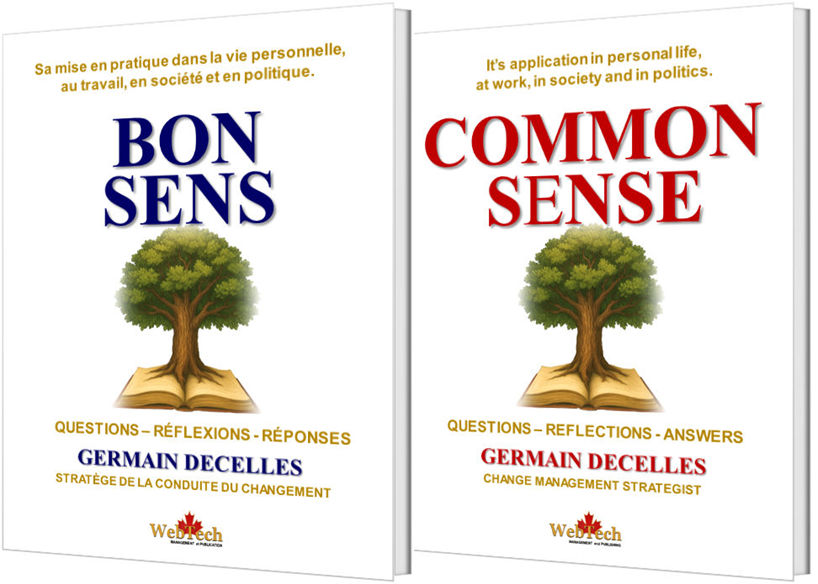
of shaping a better future, I suggest the book COMMON SENSE.
This book is designed to guide you in creating a clear roadmap
for personal growth, success, and happiness, a roadmap that
requires neither a compass, nor a GPS, nor a mobile app, just
a bit of lucidity.
Through a series of questions, quotations, and reflections,
COMMON SENSE, offers readers the tools they need to explore
their own soul in depth, discover their true passions, and
improve both their effectiveness and their efficiency. This,
in turn, allows them to shape their own success and then help
those around them achieve the same goal, without having to
reinvent the wheel each time.
The ideas presented in this book draw on forty years of
experience working with local and international organizations,
businesses, and consulting services in change management,
transition, and marketing.
Available:
To download this and
previous articles, go to WebTech Publishing (www.webtechpublishing.com
and click on the green image (e-NewsLine).
To learn more about
how to inspire success, visit WebTech Management and
Publishing Incorporated (www.webtechmanagement.com)
and click on the blue image (Wise whiZ) at the bottom right of
the screen.
—30 —
|