|
The quotations, short texts, and
photographs in this work remain the exclusive property of
their respective authors.
Available in PDF format
|
COMMON SENSE –
The book
A critical reading
In a perspective of supporting the reader, we used the
Copilot AI software in order to offer two levels of
critical analysis of the book Common Sense.
A :
A critical approach
B :
An argued (or reasoned) defense |
 |
A: A CRITICAL APPROACH
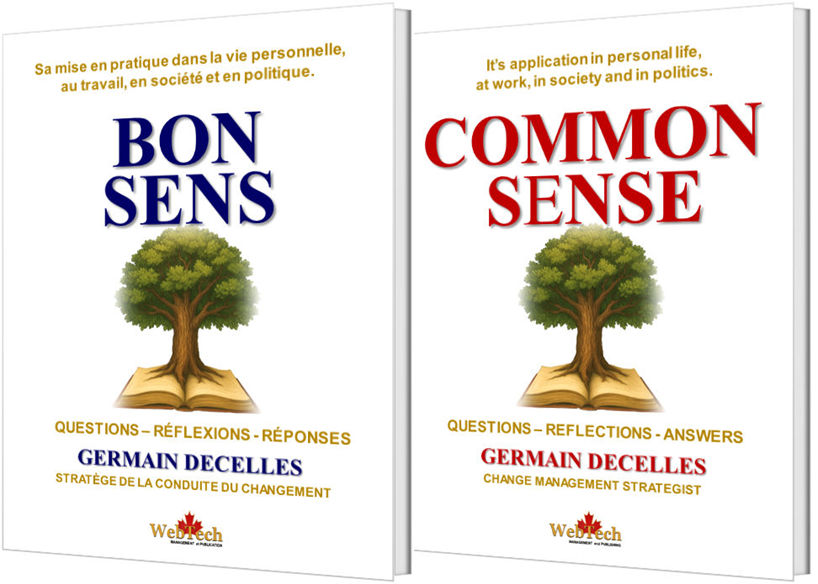
This analysis offers a critical reading of the book Bon
Sens, one that is deliberately firmer, more dialectical,
and more demanding. In its study, Copilot AI adopts an
approach that consists in treating the work as a thesis to be
examined rigorously. The aim is to put it to the test,
confront its arguments, identify its limits, and explore its
possible contradictions. The objective is not to discredit it,
but to reveal its true scope.
Such an approach requires taking the text seriously, analyzing
its internal coherence, the strength of its arguments, and its
conceptual intentions. This reading does not limit itself to
approving or refuting; it seeks to understand what the work
asserts, what it actually demonstrates, and what it leaves
unresolved. It is within this perspective that the analysis is
situated, aiming to bring out the value of the book by
subjecting it to a methodical and rigorous examination.
1. A rehabilitation of common sense… that risks turning it
into a myth.
The book aims to restore common sense to a central place in
modern life.
But this ambition encounters a fundamental
tension:
Common sense is presented as a rare resource, while at the
same time being assumed to be accessible to everyone.
This is a classic contradiction:
·
If common sense is universal, why is a book needed to teach
it?
·
If it is rare, how can it be universal?
This ambiguity sometimes weakens the thesis.
One senses
that the author wants both to democratize and to sanctify
common sense — a difficult balance to maintain.
2. A critique of complexity… that sometimes oversimplifies.
The book often contrasts common sense with the artificial
complexity of the contemporary world. It is appealing, but it
can become problematic.
Dialectically,
one could say:
·
Yes, complexity can be a smokescreen.
·
But no, simplicity is not always synonymous with truth.
Some situations require technical, abstract, and specialized
thinking.
In such cases, common sense can become an
anti‑intellectual alibi, a way of rejecting what one does
not understand.
The risk:
Confusing clarity with reductionism.
3.
An ethics of responsibility… that relies on an idealized
subject
The book values individual responsibility, humility, and
constant adjustment.
This is admirable, but it presupposes
an almost Stoic subject, always capable of distance, lucidity,
and self‑mastery.
·
Yet, philosophically, this is debatable:
Human beings are
shaped by biases, impulses, and determinism.
·
Common sense can be distorted by culture, education, and
social background.
·
Individual responsibility does not always suffice to
counterbalance the structures that influence our decisions.
The book sometimes tends to psychologize what is also
social, political, and economic.
4. An open method… but sometimes too vague.
The proposed method — observe, understand, decide, adjust — is
elegant.
But it may appear:
·
Too general,
·
Too obvious,
·
Too weakly equipped.
One could say:
The book describes what someone with common sense already
does, without explaining how to actually acquire it.
This is the paradox of pragmatic approaches:
they are
powerful in action, yet difficult to transmit in theoretical
form.
5. A philosophy of autonomy… that overlooks power relations.
The book values autonomy, lucidity, and personal
decision‑making.
But this view can be criticized:
·
Not everyone has the same room to maneuver.
·
An individual’s common sense can be crushed by the constraints
of an organization.
·
Lucidity is not always enough to change a situation.
The risk is slipping into a meritocratic ideology:
if you don’t succeed, it’s because you lack common sense.
Yet critical philosophy (Foucault, Bourdieu, Arendt) reminds
us that:
Individual freedom is always embedded within structures.
The book says little about this.
6. A practical wisdom… that sometimes lacks radicalness
The book offers a modest, every day, embodied form of wisdom.
That is its strength. But it is also its limitation.
One could fault it for:
·
Not going far enough in social critique,
·
Failing to question the systems that produce absurdity,
·
Focusing on the individual rather than on structures.
It is a philosophy of adjustment, not of
transformation.
Dialectical conclusion
Thesis:
common sense is an essential resource for living better.
Antithesis:
common sense is a vague concept, sometimes idealized,
sometimes instrumentalized.
Synthesis:
common sense is useful, but only if it is understood as a
critical practice, aware of its limits, its biases, and
its social conditions.
The book opens this path but does not always follow it through
to the end.
B: AN ARGUED (OR REASONED) DEFENSE
It is a reasoned, structured, and rigorous response that
examines each of the previously formulated critiques in turn.
The goal is not to avoid these objections, but to show how the
book Common Sense proves coherent on the
philosophical, methodological, and ethical levels.
1. The book does not idealize common sense: it problematizes
it.
Critique:
common sense would be presented as both universal and rare.
Defense: this tension is not a weakness, but the very
core of the concept.
The book adopts a stance close to classical moral philosophy:
·
Common sense is universal in principle:
every human being can access it.
·
It is rare in practice:
few people cultivate it consciously.
This is exactly the structure of the virtues in Aristotle:
Everyone can be courageous, but few actually are.
The book therefore does not mystify common sense:
it
deconstructs it and recontextualizes it as a
skill to be exercised, not as a natural gift.
2. The book does not simplify the world: it simplifies access
to the world
Critique:
valuing simplicity could risk sliding into simplism.
Defense: the book does not advocate simplicity against
complexity, but simplicity after complexity.
It stands within a tradition that runs from Pascal to
Einstein:
‘Things should be made as simple as possible, but not
simpler.’
The book does not deny the necessity of expertise.
It fights instead against:
·
Artificial complexity,
·
Unnecessary jargon,
·
Deliberate confusion,
·
Sophistication that masks the absence of substance.
It does not say: ‘Everything is simple.’
It says: ‘what is
essential must be capable of being clarified.’
This is an anti‑obscurantist position, not an
anti‑intellectual one.”
3. The book does not assume an ideal subject: it proposes a
subject in the making.
Critique:
the book’s ethics would rely on an individual who is too
lucid, too responsible.
Defense: the book does not
describe an actual subject, but a regulative horizon.
As in Kant, the ideal is not a description but a direction.
The book does not say:
‘You are already capable of all
this.’
It says:
‘Here is what you can strive toward.’
This is an ethic of progression, not perfection.
It
acknowledges biases, limits, and determinism, yet maintains
that:
·
Attention can be cultivated,
·
Lucidity can be trained,
·
Responsibility can be expanded.
This is not naïve: it is voluntarist.
4. The method is not vague: it is deliberately minimal.
Critique:
observing, understanding, deciding, adjusting would be too
general.
Defense: the strength of this method lies
precisely in its universal portability.
It works like:
·
The scientific method (observe → hypothesis → test →
revision),
·
Aristotelian prudence (perception → deliberation → action →
correction),
·
Continuous‑improvement cycles (PDCA:
Plan – Do – Check – Act).
It is not a recipe; it is a mental framework.
A
simple yet robust framework that can be applied:
·
In management,
·
In human relationships,
·
In decision‑making,
·
In problem‑solving.
Simplicity is not a flaw: it is a condition for usability.
5. The book does not ignore structures: it chooses its field
of action
Critique:
too individualistic, not attentive enough to power relations.
Defense: the book does not deny structures; it focuses on
what the individual can actually control.
It adopts a pragmatic stance:
·
We do not control systems.
·
We control our decisions, our perceptions, our reactions.
This is a philosophy of local agencies, not a global
critical theory.
And this local agency is far from
negligible: an individual endowed with common sense is harder
to manipulate, infantilize, or instrumentalize.
Common sense becomes a micro‑resistance, a form of
inner sovereignty.
6. The book is not lacking in radicalness: it is radical in a
different way
Critique:
the book lacks transformative ambition.
Defense: it
proposes transformation by capillarity, not by rupture.
It does not seek to overturn the world, but to transform:
·
The way of seeing,
·
The way of understanding,
·
The way of acting.
This is an everyday radicalness, close to:
·
Phenomenology (return to the real),
·
Stoicism (self‑mastery),
·
Pragmatism (concrete effectiveness).
It is not spectacular, but it is lasting.
Synthesis: why the book holds together
In the face of criticism, one can argue that Common Sense:
·
Assumes a philosophy of lucidity,
·
Proposes an ethic of progressive responsibility,
·
Offers a simple yet effective method,
·
Strengthens individual autonomy,
·
And advances a realistic, not utopian, form of transformation.
It does not claim to solve everything.
It proposes an
art of living within complexity, without getting lost in
it.
And that is precisely what gives it its strength.
Available:
To download this and
previous articles, go to WebTech Publishing (www.webtechpublishing.com
and click on the green image (e-NewsLine).
To learn more about
how to inspire success, visit WebTech Management and
Publishing Incorporated (www.webtechmanagement.com)
and click on the blue image (Wise whiZ) at the bottom right of
the screen.
—30 —
|












