|
The quotations, short texts, and
photographs in this work remain the exclusive property of
their respective authors.
RATIONAL THINKING: The Subtle Art of Taking Back
Control
There are moments when everything seems to move too fast, as
if life had secretly pressed the “fast‑forward” button.
Emotions overflow, reactions pile up, and suddenly you’re
buying things you didn’t even know existed five minutes
earlier. In the middle of this perfectly choreographed chaos,
a small inner voice desperately tries to find something to
hold on to, anything that might keep you from turning into an
emotional tornado.
That’s when rational thinking steps in. Not as a capped
superhero, of course. More like a calm friend who gently
places a hand on your shoulder and whispers, “Breathe. You
don’t have to answer right now.” It’s not an intellectual
luxury. It’s more like a mental “pause” button — the one we
forget to use before making a decision we’ll regret later,
sometimes very, very quickly.
It often begins with a tiny gesture:
stopping the impulse.
A breath.
A step back.
That moment when you realize that
contrary to what your emotions insist, the world will not
collapse if you wait ten seconds before hitting “send.” In
that small space, pros and cons fall back into place, facts
separate from interpretations, and raw emotion finally stop
acting like the conductor of the orchestra. “I react” slowly
becomes “I think.”
And, miraculously, something inside
relaxes.
Rational thinking is not a cold machine. It relies on a much
more familiar ally: common sense. That discreet little voice —
sometimes teasing, raising an inner eyebrow when you’re about
to do something foolish, sometimes gentle — reminding you that
not everything needs to be immediate. It suggests that some
decisions are better left to settle, that urgency rarely leads
to wisdom, and that no, having an idea at 2 a.m. does not
automatically make it brilliant.
Common sense is everyday wisdom. The kind that quietly guides
you back, to what truly matters, even when your emotions try
to drag you into an improvised marathon.
For centuries, humans have been described as rational beings.
And yet, everyone knows the truth is more complicated. We are
made of sudden impulses, irrational fears, strange biases, and
reflexes that are… questionable at best. Rationality doesn’t
erase any of that. It simply helps us navigate this delightful
inner mess without drowning in it.
In tense situations, it invites us to pause. To look at what’s
happening inside before letting words escape faster than
thought. To acknowledge anger, panic, or sadness without
handing them the keys to the car. This distance prevents
unnecessary wounds, irreversible actions, and conflicts that
ignite faster than an unattended barbecue. It reveals an inner
maturity that turns confrontation into dialogue.
In a world saturated with information, rational thinking
offers another reflex: checking. Distinguishing what we know
from what we assume. Recognizing our biases — those tiny
invisible creatures that push us to jump to conclusions.
Leaning on facts rather than impressions. Not to become
infallible — no one is — but to act with a bit more solidity.
It also shapes the way we meet others. Listening without
interrupting. Clarifying what gets muddled. Expressing our
thoughts without aggression. Seeking common ground rather than
victory. Rational thinking doesn’t aim to win arguments; it
aims to prevent them from turning into Greek tragedies.
And then there’s the future.
Rational thinking draws paths. It turns
dreams into projects, desires into goals, intentions into
actions. It asks us to clarify what we truly want, adjust our
trajectory when life shifts, and stay aligned with our deeper
priorities — even when the temptation to give up everything
grows strong.
Ultimately, balancing reason and emotion is one of the great
challenges of being human. We are not machines. We are crossed
by intuitions, fears, bursts of enthusiasm, and sometimes
wildly impractical ideas. Rational thinking doesn’t try to
extinguish any of that. It accompanies it. It channels it. It
transforms emotion into constructive force.
It imposes nothing.
It illuminates.
And sometimes, that light is all we need
to take back control — without drama, without panic, and with
a smile to top it off.
Now, many other avenues of reflection
deserve attention.
Fear, for instance, strongly shapes our
decision‑making logic and can slow down our ability to act
with clarity. Managing that fear becomes a central part of the
decision process, influencing how we move forward or pull
back.
The very idea of rationality also varies across cultures and
traditions, each with its own way of blending logic,
intuition, and collective wisdom. In politics, the balance
between rational analysis and emotional resonance shapes how
decisions are made and received, showing the importance of
combining both rather than favoring one exclusively.
In human relationships, logic and emotion intertwine, respond
to each other, and influence the quality of the bonds we
create.
And of course, this list is only a beginning. Countless other
aspects deserve exploration to fully understand the dynamic
between rationality, emotion, and human behavior.
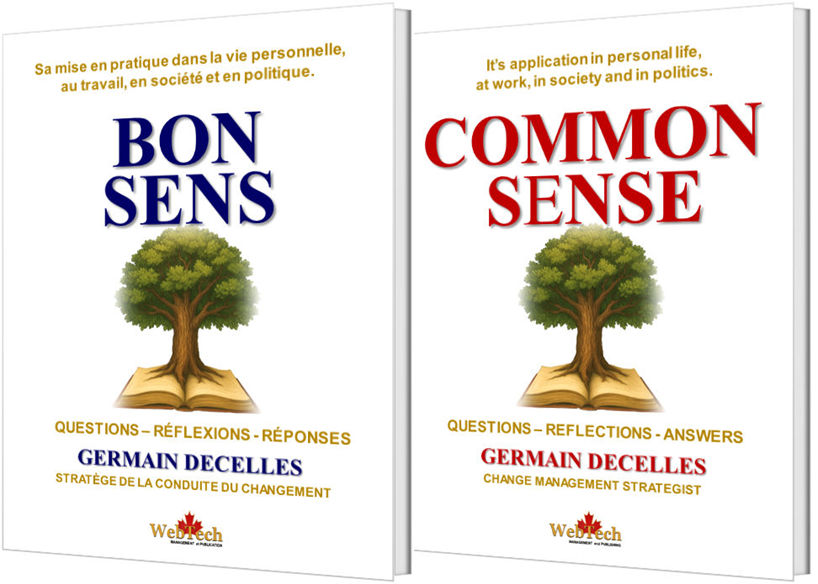
At WebTech Publishing, we created COMMON SENSE because it
offers a concrete, solid, and deeply practical framework for
regaining direction and rebuilding life with intention. For
anyone who feels they’ve drifted, or that the world has become
too chaotic to navigate, this book serves as a true compass.
To reconnect with clarity in a world that
never stops accelerating, simply explore COMMON SENSE at
webtechpublishing.com.
For more information, we invite you to visit:
www.webtechpublishing.com
-30-
Available:
To download this and
previous articles, go to WebTech Publishing (www.webtechpublishing.com
and click on the green image (e-NewsLine).
To learn more about
how to inspire success, visit WebTech Management and
Publishing Incorporated (www.webtechmanagement.com)
and click on the blue image (Wise whiZ) at the bottom right of
the screen.
—30 —
|