|

The quotations, short texts, and
photographs in this work remain the exclusive property of
their respective authors.
MERIT – An ancient principle, a modern challenge
Merit travels through history like a tireless old sage: from
ancient Greece, where philosophers were already arguing about
who deserved what, all the way to modern organizations, where
the real debate is more often about who finished the last box
of donuts.
For as long as anyone can remember, it has served to recognize
the true value of work, to distinguish sincere effort from
mere appearances, and to spot solid contributions amid
superficial actions that shine for five minutes… then vanish
like a Bengal flare that grabs attention but doesn’t last
long. Yet today, merit is sometimes misunderstood: some
inflate it like a hot‑air balloon, others pop it just as
quickly.
For some, merit is seen as a form of favoritism, a bit like a
private club you enter with a secret password. For others, it
becomes the universal explanation for every success, even when
that success rests more on luck, privilege, or a well‑stocked
address book than on genuine effort. Between these two
extremes, there is fortunately a more reasonable path: that of
a fair, transparent, and respectful kind of merit, one that
brings people together rather than driving them apart. In
short, a form of merit that doesn’t play favorites… not even
with itself.
In an organization, merit isn’t a moral gadget you pull out to
decorate speeches. It’s an essential tool for managing work
well. When it’s recognized consistently, everyone understands
that their efforts aren’t disappearing into some
administrative black hole. Progress gets noticed, commitment
matters, and motivation rises, not just because of rewards,
but because the rules finally feel… fair. A small miracle in
the workplace.
Conversely, when merit is ignored, decisions become arbitrary.
You start seeing promotions based on favoritism, choices
shaped by internal politics, or rewards handed to those who
speak the loudest rather than those who do the work well. A
well‑structured culture of merit prevents these excesses. It
relies on clear rules, precise criteria, and decisions that
can be explained without needing a 300‑page novel.
Recognizing merit isn’t just about applauding the top
performers. It’s also about encouraging those who want to
grow. Merit then becomes an educational tool: it shows what is
expected, what is valued, and what needs improvement. In
short, it’s a GPS for learning… but without recalculating
every five seconds. It fosters initiative, autonomy, and the
desire to improve, which, let’s be honest, is always more
useful than a three‑hour meeting to say the same thing.
A society that values merit sends a clear message: everyone
can contribute, everyone can progress, and everyone can be
recognized for their efforts, even those who still can’t fold
a fitted sheet on the first try. This doesn’t mean everyone
starts with the same advantages (some begin with running
shoes, others with sandals), but it does mean that effort,
perseverance, and skills can genuinely shape each person’s
path. This vision strengthens trust in institutions, shared
rules, and the idea that some form of social justice still
exists… somewhere.
Merit also plays a key role in the organization of a society,
because it manages to bring together two values that usually
eye each other like wary cats ready to scratch: freedom and
solidarity.
On one side, freedom encourages each person to take
initiative, develop their talents, and move forward by their
own means — like an explorer enthusiastically charting their
own path. On the other side, solidarity ensures that no one
gets stuck on the side of the road without a GPS, without a
map, and without a helping hand to get going again.
By combining these two values, merit creates an essential
balance. It acknowledges the importance of individual effort
while reminding us that society must offer fair starting
conditions.
Freedom pushes individuals forward, while solidarity gives
them a little boost when the slope becomes too steep.
Together, they create a framework where personal effort is
encouraged without ever forgetting mutual support and social
justice, a duo as complementary as coffee and Monday‑morning
motivation.
Without a genuine consideration of merit, a society can slide
into dependency or excessive indulgence, where everyone gets a
trophy just for showing up. Conversely, a society obsessed
with merit can turn into a nonstop competition where even the
breaks are timed. The challenge, then, is to find a balance
where solidarity supports effort, and effort strengthens
solidarity, like a well‑tuned tandem bike.
When merit disappears, mediocrity settles in: institutions
lose credibility, citizens lose trust, and organizations
become less effective. Merit ultimately reminds us that
quality, integrity, and competence aren’t optional, they’re
essential conditions for a society to endure… and to avoid
spinning in circles like a tired top.
Merit isn’t just a word or a slogan pinned to a wall. To be
credible, it must rest on clear, consistent, and
understandable criteria. An opaque or easily manipulated merit
system becomes unfair and loses all value, like a game whose
rules are invented on the fly, by whoever’s winning.
Merit isn’t limited to numerical results. It takes into
account the quality of the work, the consistency of effort,
the ability to collaborate, respect for ethics, the
willingness to learn, and the positive impact on others. In
short, it looks at the whole picture, not just the final
score.
Finally, recognition of merit must be given at the right
moment, in the right way, and for the right reasons.
Recognition given at the wrong time is like applauding at the
wrong moment during a concert: it breaks the mood and doesn’t
encourage anyone to keep going.
Establishing a culture of merit isn’t just about adding yet
another rule to a manual already as thick as a phone book.
It’s a true cultural shift, the kind that can transform how an
organization or a society functions, a bit like discovering
that the office coffee machine actually has a “stronger”
setting.
To succeed in this transformation, leaders must show courage,
because sometimes old habits need to be questioned, the kind
that clings on like an old sticky note forgotten on a computer
screen. It’s also essential for institutions to be consistent
with one another: nothing is more frustrating than a merit
principle applied with shifting standards, like a rule that
changes depending on the mood of the day.
A shared vision is therefore indispensable so that everyone
understands where we’re trying to go. And above all, building
a culture of merit requires the willingness to raise
expectations, to encourage rigorous behavior rather than
lowering the bar until it touches the floor.
Merit is not meant to create power struggles or allow some
people to play the pack leader. On the contrary, it serves as
a tool to help each person grow. When applied properly, it
allows individuals to take responsibility for their own path,
understand what they need to improve, and recognize their
progress, like an honest mirror, but without the snarky
comments.
It also encourages participation in collective success,
because everyone knows their efforts can truly make a
difference. And merit brings a sense of dignity and meaning,
both at work and in social life, since it values effort,
perseverance, and personal contribution, three qualities that,
unlike pens in an office, don’t mysteriously disappear.
Thus, a well‑established culture of merit, doesn’t seek to
exclude people, but to help them rise. It aims to create an
environment where everyone can grow, be recognized, and find a
place that matches their efforts and skills. In short, a place
where you move forward because of what you do… and not just
because of who you know.
In conclusion, merit is neither a vague idea nor an opinion
pulled out at random like a fortune cookie. It is a true
organizing principle, a moral GPS that keeps behavior from
veering into the ditch. It also serves as an engine for
progress, a reliable one, not the kind that starts blinking
the moment you turn the key, for individuals as well as for
the community.
When understood and applied correctly, merit strengthens
justice, improves performance, and builds lasting trust. And
no, it’s not just about handing out medals: it also values
effort, perseverance, responsibility, and each person’s real
contribution, even when no one is watching.
In the workplace, merit makes it possible to objectively
recognize those who invest themselves, develop their skills,
and genuinely contribute to the organization’s success. It
encourages engagement, because everyone knows their efforts
can be noticed, not just by the coffee machine.
Management based on merit creates an environment that is more
motivating, fairer, and more effective. It reduces the risk of
favoritism (the famous “boss’s cousin”) and strengthens the
credibility of decisions made by leaders.
In society, merit also plays an essential role. It reminds us
that social progress does not depend solely on starting
conditions, but also on the effort made and the choices
individuals take. It reinforces trust in institutions and
shared rules, because it gives people the sense that they can
be recognized for what they truly contribute, not just for
their ability to speak loudly in meetings. Merit thus helps
raise the collective level by encouraging quality, integrity,
and responsibility.
For more effective management, whether in organizations or in
society as a whole, merit remains a solid and necessary
foundation. It is not a theoretical concept stored in a dusty
drawer, but a concrete tool for building a fairer, more
efficient, and more harmonious environment. By valuing effort
and competence, merit allows everyone to move forward and
keeps society from spinning in circles like a poorly adjusted
office chair.
To help you apply these ideas to your personal development,
and to become a more effective and authentic person, capable
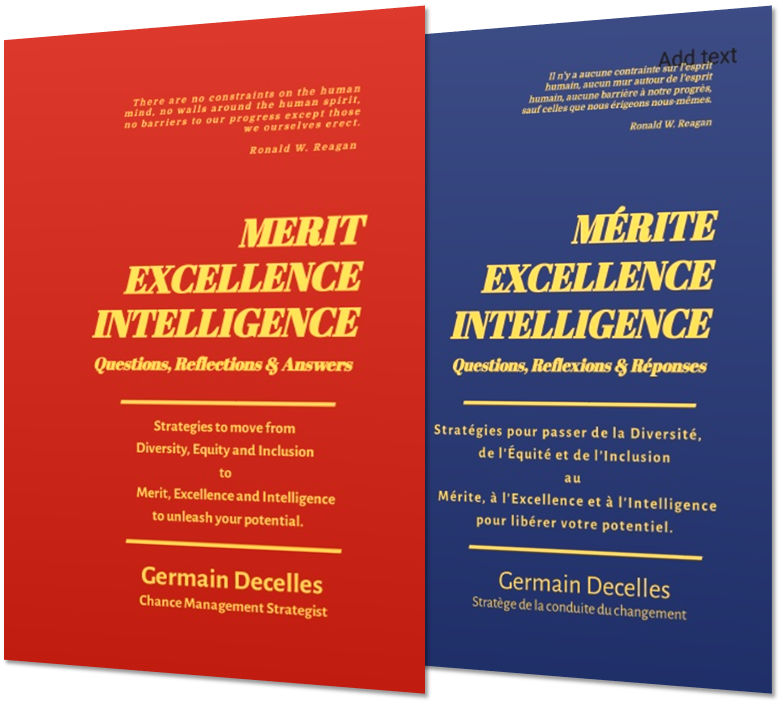
of shaping a better future, I suggest the book MERIT,
EXCELLENCE, INTELLIGENCE.
This book is designed to guide you in creating a clear roadmap
for personal growth, success, and happiness, a roadmap that
requires neither a compass, nor a GPS, nor a mobile app, just
a bit of lucidity.
Through a series of questions, quotations, and reflections,
MERIT, EXCELLENCE, INTELLIGENCE offers readers the tools
they need to explore their own soul in depth, discover their
true passions, and improve both their effectiveness and their
efficiency. This, in turn, allows them to shape their own
success and then help those around them achieve the same goal,
without having to reinvent the wheel each time.
The ideas presented in this book draw on forty years of
experience working with local and international organizations,
businesses, and consulting services in change management,
transition, and marketing.
Available:
To download this
and previous articles, go to WebTech Publishing (www.webtechpublishing.com)
and click on the green image (e-NewsLine).
To learn more about
workshops, conferences, and group or individual talks, visit
WebTech Management and Publishing Incorporated (www.webtechmanagement.com)
and click on the blue image (Wise whiZ) at the bottom right of
the screen.
—30 —
|