|

The quotations, short texts, and photographs in this
work remain the exclusive property of their respective
authors.
Available in PDF format
|
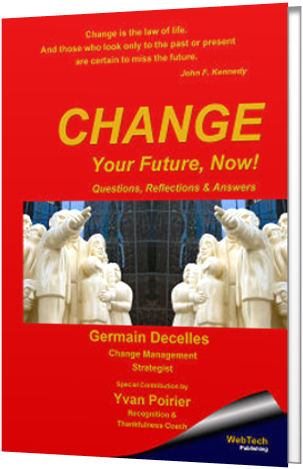
CHANGE YOUR FUTURE, NOW!
–
THE BOOK
A critical reading
In a perspective of supporting the reader, we used the
Copilot AI software in order to offer two levels of
critical analysis of the book Change your Future, Now!
A: A critical approach
B: A
Comparative Analysis: |
 |
A: A CRITICAL APPROACH
Germain Decelles’s Change Your Future, Now! positions itself
within the broad tradition of motivational literature, yet it
carries a distinctive voice shaped by the author’s long career
in business, change management, and organizational leadership.
The book’s central promise—that individuals can deliberately reshape
their future through mindset, clarity, and disciplined
action—aligns with the ethos of contemporary self‑development
culture. However, its structure, rhetorical strategies, and
philosophical underpinnings reveal a more complex project than
a simple “self‑help manual.”
A Hybrid Between Workbook, Manifesto, and Personal Philosophy
One of the book’s most striking features is its interactive, cyclical
structure. Rather than presenting a linear argument,
Decelles organizes each chapter around a recurring triad:
Questions → Reflections → Answers. This format encourages
readers to pause, interrogate their assumptions, and actively
participate in the meaning‑making process. It echoes the
Socratic method but translated into a modern, accessible,
workbook‑style experience.
This structure is both a strength and a limitation. On one hand, it
democratizes self‑inquiry, making the book approachable for
readers of varied backgrounds. On the other, the repetition
can feel formulaic, and the absence of a cumulative
argumentative arc may frustrate readers seeking a more
rigorous theoretical framework.
The Ideological Core: Personal Agency as Destiny
At the heart of the book lies a philosophy of radical personal
responsibility. Decelles insists that individuals—not
circumstances, institutions, or luck—are the primary
architects of their future.
This stance resonates with the meritocratic optimism of authors like
Stephen R. Covey or James Clear, yet Decelles frames it with a
more humanistic tone. Success is not merely an achievement; it
is the outcome of self‑knowledge, disciplined habits,
emotional maturity, and ethical conduct.
The book’s emphasis on attitude as a causal force—the idea that
mindset precedes and shapes reality—is a recurring motif.
While this aligns with cognitive‑behavioral principles and
contemporary psychology, the argument occasionally risks
oversimplifying structural or socio‑economic constraints. The
text’s universalizing tone (“Anyone can change their future”)
is inspiring, but it sometimes glosses over the complexities
of inequality, trauma, or systemic barriers.
Common Sense as Moral Compass
A distinctive contribution of Decelles’s work is his elevation of
“common sense” as both a practical tool and a moral
framework. For him, common sense is not banal intuition but a
disciplined clarity—a way of cutting through noise, ego, and
emotional distortion to act with integrity and purpose. This
reframing gives the book a philosophical dimension that sets
it apart from more corporate‑leaning self‑help literature.
However, the concept remains somewhat under‑theorized. While Decelles
champions common sense as universal, the book does not fully
explore how cultural, historical, or psychological factors,
shape what different people perceive as “common.” The result
is a compelling but occasionally idealized notion of shared
wisdom.
Rhetorical Style: Accessible, Motivational, and List‑Driven
Stylistically, the book favors short sections, bullet points,
aphorisms, and practical lists. This makes it highly
digestible and suitable for readers who prefer actionable
guidance over dense theory. The tone is consistently
encouraging, inclusive, and forward‑looking.
Yet this accessibility comes at a cost. The reliance on lists and
motivational statements sometimes dilutes the depth of the
underlying ideas. Readers seeking a more scholarly or
research‑driven approach may find the book’s evidence base
thin, as it leans more on experience, observation, and
common‑sense reasoning than on empirical studies.
Strengths
-
Engaging,
participatory structure that
invites readers to think rather than passively absorb.
-
Clear,
motivational tone that
speaks to a wide audience.
-
Philosophical coherence, especially around
personal agency and ethical self‑development.
-
Practicality, with concrete suggestions that can be
implemented immediately.
Limitations
-
Lack of
theoretical depth in areas
where concepts (e.g., common sense, mindset) could be more
rigorously defined.
-
Occasional oversimplification of
complex socio‑economic realities.
-
Repetitive structure, which may feel
redundant to analytically oriented readers.
Overall Evaluation
Change Your Future, Now!
succeeds as a motivational and reflective guide for readers
seeking clarity, direction, and personal transformation. Its
strength lies in its humanistic optimism and its
insistence that change begins with honest self‑examination.
While it may not satisfy readers looking for academic rigor or
systemic analysis, it offers a coherent, accessible, and often
inspiring roadmap for personal growth.
Decelles’s voice—experienced, earnest, and morally grounded—gives the
book a sincerity that distinguishes it from formulaic
self‑help titles. Ultimately, the book’s value depends on the
reader’s willingness to engage with its reflective exercises
and to embrace its central premise: that the future is not
something to be predicted, but something to be shaped.
B: A COMPARATIVE ANALYSIS
Germain Decelles’s Change Your Future, Now! sits at an intriguing
crossroads in the landscape of personal development
literature. It shares thematic DNA with several major
thinkers—Covey, Sinek, Carnegie, Brown, Clear, and Frankl—yet
it also resists being absorbed into any single lineage. The
book’s philosophical backbone, built on common sense, personal
responsibility, and ethical clarity, allow it to converse with
these authors while maintaining its own distinct voice.
Decelles and Covey: Structure vs. Intuition
Stephen R. Covey’s The 7 Habits of Highly Effective People is
perhaps the closest structural cousin to Decelles’s work. Both
authors insist that personal transformation begins with
internal alignment, and both elevate interdependence as
the highest form of maturity. Covey’s “public victory” mirrors
Decelles’s conviction that success is relational and mutually
reinforcing.
Yet the divergence is equally telling. Covey builds a system,
complete with paradigms, principles, and sequential habits.
Decelles builds a philosophy, grounded in clarity,
reflection, and common sense. Where Covey offers architecture,
Decelles offers orientation. Covey prescribes; Decelles
invite.
Decelles and Sinek: Purpose and Service
Simon Sinek’s Start With Why and Leaders Eat Last share
with Decelles a deep belief in service-oriented leadership.
Both argue that leaders succeed by elevating others, fostering
trust, and creating environments where people can thrive.
Decelles’s relational ethos—“Your success is tied to the
success of others”—echoes Sinek’s, “Circle of Safety.”
But Sinek’s method is investigative, supported by organizational case
studies and biological metaphors. Decelles’s method is
contemplative, grounded in lived experience and philosophical
reasoning. Sinek operationalizes interdependence; Decelles
moralizes it.
Decelles and Carnegie: Technique vs. Principle
Dale Carnegie’s classic How to Win Friends and Influence People
shares Decelles’s conviction that relationships are the
engine of personal and professional success. Both
emphasize empathy, listening, and mutual benefit.
The difference lies in the level of abstraction. Carnegie is pragmatic
and technique-driven, offering behavioral strategies for
influence. Decelles is principle-driven, focusing on the
mindset and ethical posture that make relationships
meaningful. Carnegie teaches how to build
relationships; Decelles explains why shared success
matters.
Decelles and Brené Brown: Vulnerability and Integrity
Brené Brown’s work on vulnerability, courage, and authenticity resonates
strongly with Decelles’s humanistic tone. Both authors argue
that ethical responsibility and emotional maturity are
prerequisites for meaningful leadership and personal growth.
Yet Brown’s framework is grounded in qualitative research, particularly
grounded theory. Her claims are supported by data, interviews,
and academic methodology. Decelles’s reasoning is experiential
and philosophical, drawing from observation and introspection
rather than empirical study. Brown provides a research-based
emotional framework; Decelles provides a moral-philosophical
one.
Decelles and James Clear: Behavior vs. Meaning
James Clear’s Atomic Habits and Decelles’s Change Your Future,
Now! share a belief in continuous improvement and
the cumulative power of small actions. Both authors are
optimistic about human potential and emphasize personal
agency.
But Clear’s work is behavioral and systems-oriented. He explains how
habits form, how cues and rewards shape behavior, and how
measurable change occurs. Decelles’s work is value-oriented.
He is less concerned with the mechanics of behavior and more
with the ethical and existential reasons for change.
Clear explains how individuals change; Decelles explains why
change should benefit others.
Decelles and Viktor Frankl: Meaning and Responsibility
The comparison with Viktor Frankl is perhaps the most philosophically
charged. Both authors emphasize purpose, responsibility,
and the ethical dimension of human action. Both believe
that individuals can shape their future by shaping their inner
world.
But the divergence is profound. Frankl’s Man’s Search for Meaning
is grounded in extreme lived experience—suffering, survival,
and the existential confrontation with meaning in the face of
horror. Decelles’s work is grounded in everyday life,
professional experience, and motivational clarity. Frankl’s
insights emerge from existential crisis; Decelles’s from
reflective observation. Frankl offers a philosophy of meaning
under duress; Decelles offers a philosophy of intentional
living in ordinary circumstances.
Where Decelles Stands in the Tradition
Taken together, these comparisons reveal Decelles as a humanistic
synthesizer. He shares Covey’s moral seriousness, Sinek’s
relational leadership, Carnegie’s interpersonal wisdom,
Brown’s emotional integrity, Clear’s optimism about
improvement, and Frankl’s emphasis on responsibility. Yet he
does not replicate any of them.
His distinctive contribution lies in his commitment to common sense as
a disciplined, ethical, and clarifying force—a kind of
modern practical wisdom. He writes not as a theorist, not as a
researcher, and not as a technician, but as a guide who
believes that clarity, honesty, and responsibility are
accessible to everyone.
In this sense, Change Your Future, Now! is less a system than a
compass, less a methodology than a philosophy of action. It
stands comfortably within the lineage of personal development
literature while offering a voice that is unmistakably its
own.
|
|
This 642‑page personal development book, available in English and
published by WebTech Publishing, is available online
at:
www.lulu.com
For more details, visit:
www.webtechpublishing.com
|
To download this
and previous articles, go to WebTech Publishing (www.webtechpublishing.com)
and click on the green image (e-NewsLine).
To learn more about
workshops, conferences, and group or individual talks, visit
WebTech Management and Publishing Incorporated (www.webtechmanagement.com)
and click on the blue image (Wise whiZ) at the bottom right of
the screen.
—30 —
|












