|
The quotations, short texts, and photographs in this
work remain the exclusive property of their respective
authors.
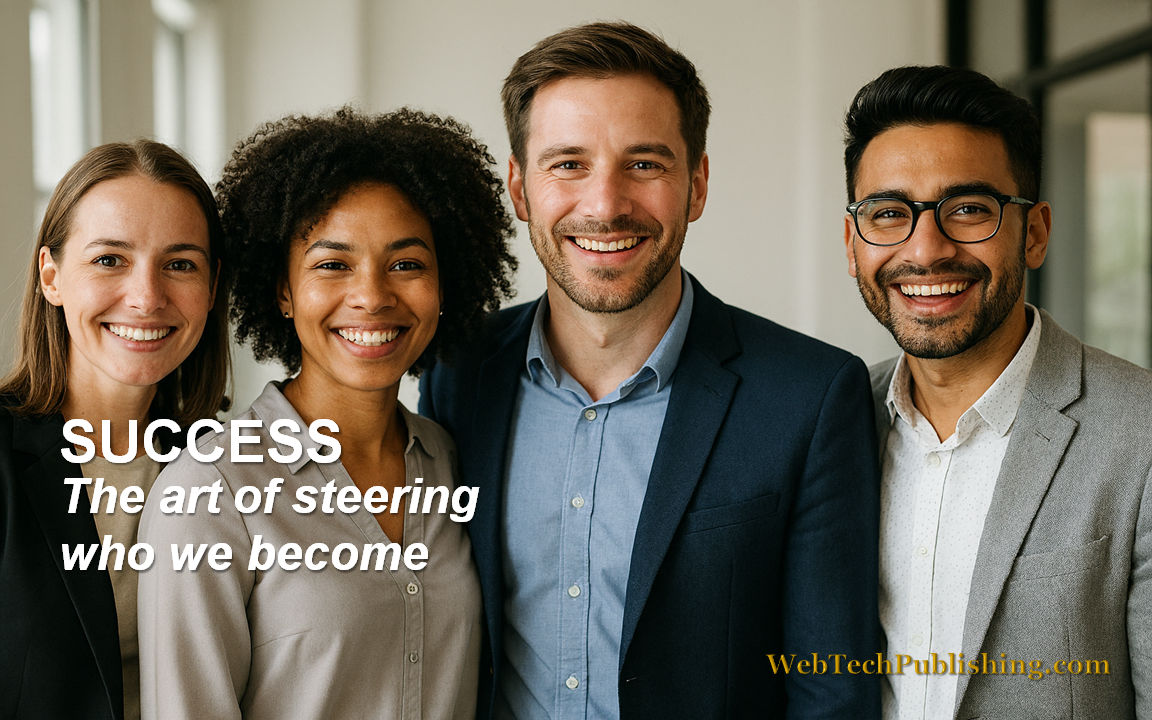
SUCCESS— The art of steering who we become
Success draws attention because it seems easy to spot,
like a neighbor who just bought an overly shiny car, yet it
remains surprisingly hard to define. We watch for it in
others, we try to capture it for ourselves, and sometimes
we’re almost afraid of it, as if succeeding might turn us into
a version of ourselves that even our own mirror wouldn’t
recognize.
And yet, when we take a step back, we realize that
success is nothing like a sudden, spectacular thunderclap:
it’s more like a slow inner simmer, a dish that takes its time
before revealing its flavor.
In truth, success is never just a final result. It’s
the visible tip of an iceberg made of invisible work—except
this one doesn’t sink anyone, it builds us. We applaud the
flower, but we forget the seed that had to face cold soil,
sunless days, and haphazard watering. Success requires
consistency, clarity of mind, and loyalty to one’s goals… even
on the days when staying under the covers feels far more
appealing.
It begins long before any goal is reached. It’s crafted
in the small daily decisions made when no one is watching, in
the sacrifices that make your teeth clench, and in the efforts
that earn no “likes.” Success is a bit like keeping a plant
alive: you have to persist even when it looks like it’s
sulking.
Et surtout, le succès n’est jamais totalement individuel. Il
dépend des relations, des encouragements, des critiques (même
celles qui piquent un peu), et des rencontres qui nous ouvrent
des portes qu’on n’avait même pas vues. Contrairement à ce
qu’on pourrait croire, le succès n’isole pas : il relie. C’est
un point de rencontre, pas un piédestal.
And above all, success is never entirely individual. It
depends on relationships, encouragement, criticism (even the
kind that stings a little), and the encounters that open doors
we hadn’t even noticed. Contrary to what we might think,
success doesn’t isolate, it connects. It’s a meeting point,
not a pedestal.
When it finally shows up, success often surprises us.
Not because it falls from the sky, but because it reveals who
we’ve become along the way. It transforms us before it rewards
us. It changes how we see ourselves, how we behave, and even
how we tell our own story. Success is therefore not a peak but
a maturation; not a firework, but a coherence settling into
place.
This construction rests on a fertile tension between
who we are and who we want to become. Success doesn’t
eliminate lack, it puts it to work. It appears when desire
stops running in every direction and turns into a clear
orientation. To succeed is not to “obtain,” but to steer. It
means accepting that the unfinished pushes us forward, that
imperfection calls to us, and that effort is a form of loyalty
to oneself, even when a nap sounds far more appealing.
Success is above all an inner movement. It consists in
turning discomfort into momentum and uncertainty into
trajectory. It is born where identity meets desire, where the
present converses with the future, where we agree to step
outside our habits (even the ones we’re fond of). Lack then
becomes a constructive energy, not a hole to be filled.
Success doesn’t erase weaknesses; it illuminates them
and turns them into resources. It makes the unfinished a
promise rather than a problem. When desire becomes clear,
inner chaos becomes a compass, and the dream turns into a
project.
Success begins with the ability to organize one’s
aspirations, to turn desire into intention, intention into
action, and action into progress. To succeed is no longer to
accumulate external proof, but to align one’s behaviors with
who one wishes to become. It requires moving forward despite
hesitation, persevering through dips in motivation, and
staying true to one’s values—even when Netflix releases a new
series.
True success is not a trophy but a personal
transformation. It is measured less by visible results than by
inner evolution. It appears when we stop chasing an idealized
version of ourselves and instead embrace a more authentic,
more demanding, and sometimes funnier one.
Success is therefore not an endpoint but a lasting
orientation. It doesn’t seek to eliminate lack, but to give it
meaning. It doesn’t aim for perfection, but for a just and
honest movement. And perhaps the most beautiful form of
success is simply moving forward with clarity, turning every
imperfection into an opportunity to become a little more
oneself, with humor, ideally.
Ultimately, success is neither a dazzling feat reserved
for a chosen few nor a trophy held aloft on an imaginary
podium. It is a discreet path, sometimes bumpy, often
demanding, where we mostly learn to know ourselves better.
It is built through tiny choices, quiet efforts,
encouragement received at the right moment, and moments of
self-questioning that wake us up more effectively than a
strong espresso. Success is not a bright destination on a map,
but a way of moving, adjusting, growing, and, ideally, keeping
a sense of humor when the road gets complicated.
If one had to sum it up, one could say that succeeding
is not about becoming someone else, but about becoming a
little more oneself—with consistency, courage, and a healthy
dose of self‑irony. Success isn’t what waits for us at the end
of the road; it’s the way we walk it. And perhaps that’s where
its true beauty lies.
With the aim of helping, you apply these ideas to your
personal development, and become a more effective and
authentic person, capable of shaping a better future, I
suggest the book MY SUCCESS IS
YOUR SUCCESS.
This book is designed to guide you in creating a clear
roadmap for personal growth, success, and happiness, a roadmap
that requires neither a compass, nor a GPS, nor a mobile app,
just a bit of clarity.
Through a series of questions, quotations, and
reflections, MY SUCCESS IS YOUR SUCCESS, offers readers
the tools they need to explore their own soul in depth,
discover their true passions, and improve both their
effectiveness and their efficiency. This, in turn, enables
them to shape their own success and then help those around
them reach the same goal, without having to reinvent the wheel
each time.
The ideas presented in this book draw on forty years of
experience working with local and international organizations,
businesses, and consulting services in change management,
transition, and marketing.
Available:
|

|
This 404‑page personal development book, available in
both French (America & Europe) and English and
published by WebTech Publishing, is available online
at:
www.lulu.com
For more details, visit:
www.webtechpublishing.com
|
To download this
and previous articles, go to WebTech Publishing (www.webtechpublishing.com)
and click on the green image (e-NewsLine).
To learn more about
workshops, conferences, and group or individual talks, visit
WebTech Management and Publishing Incorporated (www.webtechmanagement.com)
and click on the blue image (Wise whiZ) at the bottom right of
the screen.
—30 —
|












