|

The quotations, short texts, and photographs in this
work remain the exclusive property of their respective
authors.
Available in PDF format
|
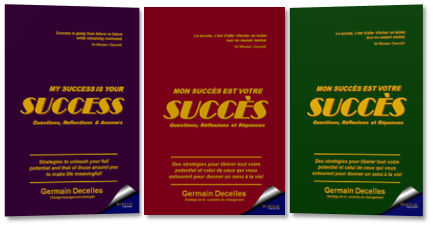
MY SUCCESS IS YOUR SUCCESS
–
THE BOOK
A critical reading
In a perspective of supporting the reader, we used the
Copilot AI software in order to offer two levels of
critical analysis of the book My Success Is Your
Success .
A: A critical approach
B: A Critical Comparison with other authors |
 |
A: A CRITICAL APPROACH
My Success Is Your Success
by Germain Decelles is a 404‑page self‑published work in the
self‑help and change‑management genre (WebTech Publishing /
Lulu, ISBN 978‑1‑7388000‑0‑1; also available in French as
Mon succès est votre succès). Decelles—a Canadian business
consultant, change‑management strategist, and an executive
with more than four decades of experience in retail, IT,
manufacturing, finance, and government—presents the book as
part of a broader series on personal and organizational
transformation.
The title’s paradox, “My Success Is Your Success,”
encapsulates the author’s central argument: personal
achievement is both an individual responsibility and a
collective good. By guiding readers toward their own success,
Decelles sees himself as advancing his mission to “spark new
intellectual capital” and “disturb the present in order to
bring forth a better LIFE.”
Structure and Rhetorical Approach
The book adopts a deliberately non‑linear, interactive format.
Its twelve thematic chapters—covering topics such as
meaningful living, self‑discovery, attitude, personal agency,
intellectual capacity, wellness, and common sense—follow a
recurring sequence of Questions → Reflections → Answers.
Readers are prompted to confront probing self‑inquiries,
reinterpret personal challenges, and then consider the
author’s prescriptive guidance.
This hybrid of Socratic questioning and workbook‑style
exercises is the book’s most distinctive feature. Rather than
presenting dense theory, Decelles relies on accessible lists,
quotations, bullet‑point advice, and motivational aphorisms.
For example, a section on cultivating a positive attitude
offers twenty‑one practical suggestions—ranging from morning
routines to gratitude practices—alongside psychological
observations presented with citations from prominent people.
The tone is consistently empowering and inclusive, addressing
a wide spectrum of readers (“students, parents, workers,
educators, artists, athletes … retirees”), while maintaining
an implicitly meritocratic stance: success is portrayed as
something achieved through one’s own actions or inaction.
Core Arguments and Ideological Foundations
Decelles advances a clear and optimistic thesis:
success—whether financial, spiritual, relational, or
legacy‑oriented—is attainable through intentional
self‑examination, mindset adjustment, continuous improvement,
and the cultivation of interpersonal skills. Several recurring
themes structure the book’s worldview:
-
Radical personal responsibility:
individuals are solely accountable for transforming their
lives.
-
Mindset as a causal force:
attitude shapes outcomes more powerfully than external
circumstances.
-
Interdependence within individualism:
although success is personally earned, it grows through
supportive relationships, delegation, family networks, and
shared moral values framed as “common sense.”
-
A change‑management perspective:
concepts such as proactive adaptation, innovation,
cognitive bias, and strategic goal‑setting reflect the
author’s corporate background.
B: A CRITICAL COMPARISON WITH OTHER AUTHORS
1. Stephen R. Covey — The 7 Habits of Highly Effective
People
Convergence
Both Decelles and Covey emphasize interdependence as a
higher stage of personal development. Covey’s “public victory”
(Habits 4–6) mirrors Decelles’s thesis that success is
relational and mutually reinforcing. Both authors reject
hyper‑individualism and argue that personal growth naturally
extends to collective benefit.
Divergence
Covey grounds his framework in a structured,
quasi‑philosophical system (character ethics, paradigms,
principles). Decelles, by contrast, relies on common‑sense
reasoning and motivational clarity rather than a
formalized model. Covey’s work is more prescriptive and
systematic; Decelles’ is more reflective and humanistic.
Critical insight:
Covey provides a conceptual architecture; Decelles provides an
ethical orientation.
2. Simon Sinek — Leaders Eat Last and Start With Why
Convergence
Sinek and Decelles share a belief in service‑oriented
leadership. Both argue that leaders succeed by elevating
others, fostering trust, and creating environments where
people thrive. The relational ethos in My Success Is Your
Success aligns closely with Sinek’s “Circle of Safety.”
Divergence
Sinek’s arguments are supported by organizational case
studies, biological metaphors, and social science research.
Decelles’s approach is more intuitive and philosophical,
without empirical scaffolding. Sinek’s tone is investigative;
Decelles’ is contemplative.
Critical insight:
Sinek operationalizes interdependence; Decelles moralizes it.
3. Dale Carnegie — How to Win Friends and Influence People
Convergence
Both authors emphasize the importance of relationships
in personal and professional success. Carnegie’s focus on
empathy, listening, and mutual benefit resonates with
Decelles’s relational model of success.
Divergence
Carnegie’s work is fundamentally pragmatic and
technique‑driven, offering behavioral strategies for
interpersonal influence. Decelles’s book is a
principle‑driven, focusing on the mindset and ethical
orientation rather than tactics.
Critical insight:
Carnegie teaches how to build relationships; Decelles
explains why shared success matters.
4. Brené Brown — Dare to Lead and The Gifts of
Imperfection
Convergence
Brown and Decelles both foreground vulnerability,
authenticity, and ethical responsibility. They share a
humanistic vision of leadership rooted in courage, empathy,
and mutual uplift.
Divergence
Brown’s work is grounded in qualitative research,
particularly grounded theory. Her claims are supported by data
and academic methodology. Decelles’s reasoning is
experiential and philosophical, not empirical.
Critical insight:
Brown provides a research‑based emotional framework; Decelles
provides a moral‑philosophical one.
5. James Clear — Atomic Habits
Convergence
Both authors emphasize continuous improvement and the
cumulative impact of small actions. They share an optimistic
view of human potential and personal agency.
Divergence
Clear’s work is behavioral and systems‑oriented,
focusing on habit loops, cues, and measurable change.
Decelles’s work is value‑oriented, focusing on ethical
responsibility and relational success rather than behavioral
mechanics.
Critical insight:
Clear explains how individuals change; Decelles explains why
change should benefit others.
6. Peter Senge — The Fifth Discipline
Convergence
Senge’s systems thinking aligns strongly with Decelles’s idea
that success is an ecosystem. Both authors argue that
individuals and organizations thrive through
interconnectedness, shared vision, and collective learning.
Divergence
Senge’s work is deeply theoretical and organizational,
drawing on systems theory, cybernetics, and learning
organizations. Decelles’ work is personal and ethical,
not technical or systemic.
Critical insight:
Senge provides the system theory Decelles implicitly gestures
toward but does not formalize.
7. Viktor Frankl — Man’s Search for Meaning
Convergence
Both authors emphasize purpose, responsibility, and the
ethical dimension of human action. Frankl’s idea that
meaning emerges through service to others resonates with
Decelles’s relational model of success.
Divergence
Frankl’s work is existential and grounded in extreme lived
experience. Decelles’s work is motivational and grounded in
everyday life. Frankl’s claims are philosophical and
psychological; Decelles’ is ethical and practical.
Critical insight:
Frankl provides existential justification; Decelles provides
practical applications.
Synthesis: Where Decelles Fits in the Intellectual Landscape
Decelles’ My Success Is Your Success can be understood
as part of a humanistic tradition that includes:
- Carnegie’s relational pragmatism
- Covey’s principle‑centered
leadership
- Sinek’s service‑oriented
leadership
- Brown’s vulnerability‑based
ethics
- Senge’s systems thinking
- Frankl’s existential
responsibility
However, Decelles’s distinctive contribution is his moral
reframing of success as inherently shared. Unlike authors
who focus on performance, influence, or organizational
dynamics, Decelles foregrounds ethical interdependence
as the foundation of meaningful achievement.
His work is less empirical, less technical, and less
systematized than many of these authors—but more
philosophically unified around a single ethical
proposition:
your success and mine are inseparable.
|
|
This 404‑page personal development book, available in
both French (America & Europe) and English and
published by WebTech Publishing, is available online
at:
www.lulu.com
For more details, visit:
www.webtechpublishing.com
|
To download this
and previous articles, go to WebTech Publishing (www.webtechpublishing.com)
and click on the green image (e-NewsLine).
To learn more about
workshops, conferences, and group or individual talks, visit
WebTech Management and Publishing Incorporated (www.webtechmanagement.com)
and click on the blue image (Wise whiZ) at the bottom right of
the screen.
—30 —
|












